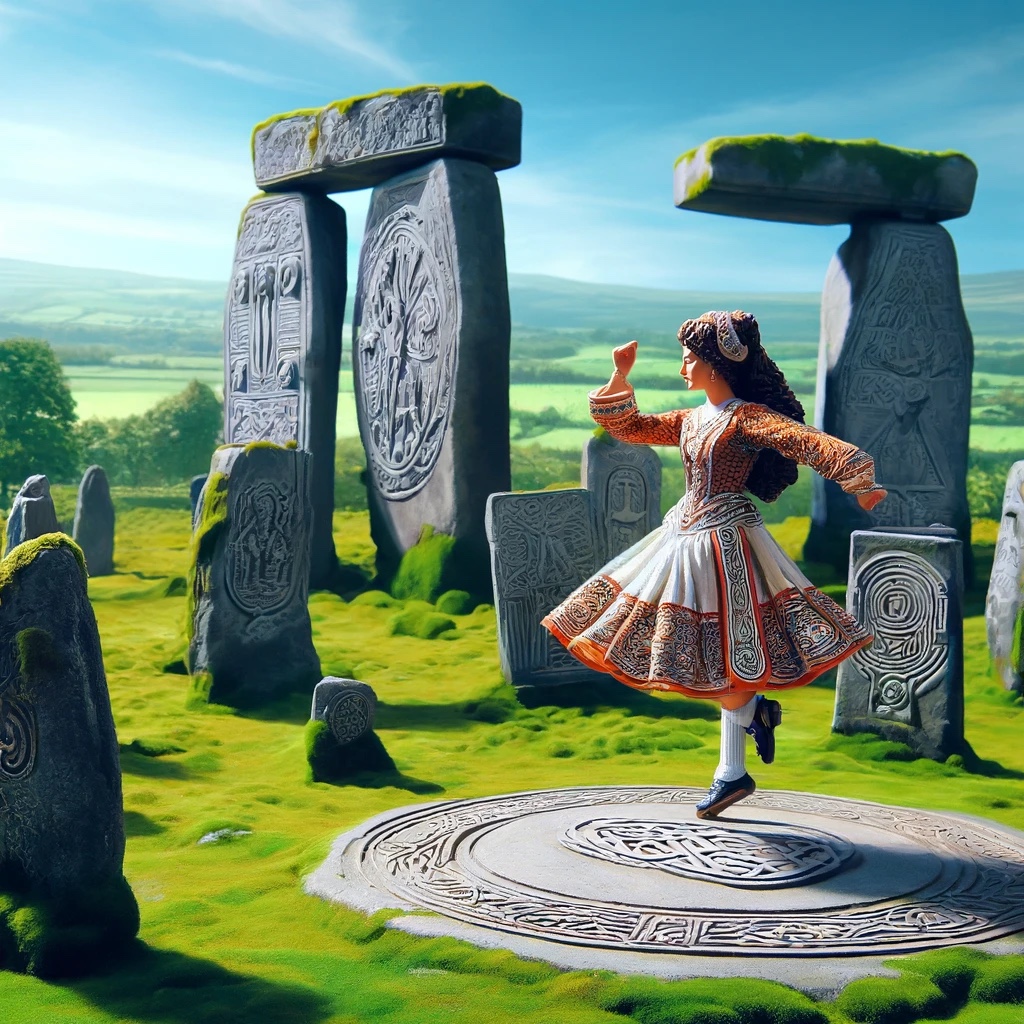
I wanted to share with you the captivating world of Irish dancing. I recently had the chance to see the Riverdance show at the Brighton Centre, and it completely blew my mind!
Irish dancing is a traditional dance form from Ireland, encompassing several styles including solo and group dances. There are two main types of Irish dance: soft shoe and hard shoe. Soft shoe dances are fluid and graceful, while hard shoe dances are known for their rhythmic and percussive sounds, similar to tap dancing.
The dance form is highly competitive and organized, with dancers often starting at a young age and competing in various competitions, including the World Irish Dance Championship.
Irish dancing also has a significant cultural aspect, being a part of Irish festivals and social gatherings, often accompanied by traditional Irish music.
Riverdance
Riverdance is a renowned theatrical show that significantly popularized Irish dancing worldwide. It started as an interval performance act during the 1994 Eurovision Song Contest, quickly evolving into a full-scale production. Riverdance blends traditional Irish dance and music with other forms, creating a dynamic and visually captivating performance. The show’s success led to numerous international tours and a greater global interest in Irish dance and culture. The influence of Riverdance has been profound, introducing millions to the art of Irish dance and paving the way for other Irish dance shows and productions.
The History
The history of Irish dancing can be traced back over centuries, deeply rooted in Ireland’s cultural and social fabric. Its origins are somewhat obscure, largely due to the scarcity of written records before the 16th century, but it’s believed to have evolved from various influences including Druidic ritual dances celebrating the oak tree and the sun, and later from Norman and English influences.
Early History
Dance was a significant part of ancient Irish society, often linked to religious rituals and seasonal festivals such as Beltane and Samhain. The Druids and Celtic priests are said to have used dance as part of their rituals, although specific details about the forms these dances took are largely speculative.
Medieval Period
By the medieval period, dancing had become a popular entertainment at social gatherings among the upper classes. The Norman invaders in the 12th century also brought their own dance traditions, which mixed with the native styles.
16th and 17th Centuries
In the 16th and 17th centuries, travel diaries and reports from visitors to Ireland began to mention dance explicitly. The dances during this time were performed in great halls and were part of the communal life of the manor, often performed in social settings like crossroads, fairs, and other gatherings.
18th and 19th Centuries
The 18th and 19th centuries saw the development of dance masters who traveled from village to village, teaching dance to the locals. These dance masters were instrumental in formalizing the dance forms and possibly in the development of the precise footwork and controlled movements characteristic of Irish dance today. Competitions, or “feiseanna,” became popular, and these events helped to standardize dances across Ireland.
20th Century to Present
Irish dancing continued to evolve and was significantly impacted by the Gaelic Revival in the late 19th and early 20th centuries, which sought to promote Irish culture. The creation of the Irish Dancing Commission (An Coimisiún le Rincí Gaelacha) in 1930 helped to formalize rules around dance competitions and further standardize the dance styles.
The global popularization of Irish dance in recent decades, especially with shows like Riverdance in the 1990s, has turned it into a widely recognized and practiced cultural art form. This has led to a surge in its popularity and the establishment of Irish dance schools around the world.
Today
Today, Irish dancing is a vibrant and thriving part of Irish culture, both in Ireland and across the world, with a strong community built around dance schools, competitions, and performances.
Learning Irish Dancing
Children can start learning Irish dancing at a very young age, often as young as three or four years old. These early classes focus on basic movements and rhythms, gradually building to more complex techniques as the dancers grow older. Many Irish dance schools offer classes that accommodate a range of skill levels, from beginners through to advanced competitors.
Competitive Dancing
Competition is a major aspect of Irish dancing today. Dancers often compete in local, regional, and national competitions leading up to the annual World Championships, which is the pinnacle of competition for Irish dancers. These competitions are highly competitive and require intense preparation, with dancers practicing multiple times a week to perfect their technique and routines.
Cultural Significance
For the Irish, dancing is more than just a form of entertainment; it’s a vital part of their cultural heritage and a way to express their national identity, especially in a global context. Irish dancing helps to maintain a connection to Irish history, traditions, and community values. It is often taught alongside Irish music and Gaelic language, reinforcing the cultural education and identity of young Irish people.
Social and Cultural Events
Beyond competitions, Irish dancing is also a fundamental part of many social and cultural events in Ireland, including weddings, festivals, and community gatherings. It serves as a bond that connects people of Irish descent with their ancestry, especially for the diaspora in countries like the United States, Australia, and Canada.
The international success of shows like Riverdance and Lord of the Dance has significantly influenced perceptions of Irish dancing, showcasing its dynamism and cultural richness to a global audience. These shows have not only elevated the profile of Irish dancing but have also inspired a new generation of dancers around the world to take up this art form.
In essence, Irish dancing remains a cherished tradition that continues to evolve, reflecting both the history and the contemporary spirit of the Irish people. It is a celebration of culture that resonates deeply with those who practice it, symbolizing a vibrant, enduring connection to their heritage.
The Celtic Stars
Irish dancing has produced several notable figures who have become stars both within the traditional Irish dance community and on international stages. Here are some of the most prominent names:
- Michael Flatley – Perhaps the most famous Irish dancer, Michael Flatley skyrocketed to fame with his performances in “Riverdance” and later with his own shows, “Lord of the Dance,” “Feet of Flames,” and “Celtic Tiger.” His innovative choreography and charismatic stage presence brought Irish dancing to a global audience.
- Jean Butler – The original female lead in “Riverdance” alongside Michael Flatley, Jean Butler is renowned for her precision and expressiveness. After her success with Riverdance, she continued to work in dance, choreographing and performing in shows and running dance workshops.
- Colin Dunne – Known for his role as the lead male dancer in “Riverdance” after Michael Flatley, Colin Dunne has also enjoyed a successful career as a solo performer and choreographer. He is acclaimed for his contemporary approach to traditional Irish dance.
- Ciara Sexton – A highly respected figure in both competitive and performance Irish dancing, Ciara Sexton has starred in shows such as “Lord of the Dance” and “Heartbeat of Home.” She is also known for her achievements in major competitions.
- Gillian Norris – Known for her role in “Lord of the Dance,” Gillian Norris captivated audiences with her dramatic performances. She has also pursued a career in modeling and acting.
These individuals have not only excelled in competitions but have also played significant roles in popularizing Irish dance worldwide through performances, teaching, and choreography. Their contributions have inspired many young dancers and helped to elevate Irish dance to a widely respected art form on the global stage.
Irish Dance Music
The evolution of Irish dance music has been deeply intertwined with the development of the dance itself, reflecting changes in style, performance contexts, and audience expectations over centuries.
Early Music Influences
Originally, Irish dance was accompanied by traditional Celtic music, which featured instruments like the harp, tin whistle, and the bodhrán (a type of frame drum). This music was primarily melodic, with simple rhythms that complemented the dance steps. The tunes were often passed down orally among musicians.
Introduction of the Fiddle and Pipes
As the fiddle and the uilleann pipes (Irish bagpipes) became more prevalent in Irish music from the 18th century onward, they brought a new dynamism to the music. The fiddle, in particular, allowed for a wider range of notes and faster playing, which encouraged more lively and intricate dancing.
Impact of Dance Masters
In the 18th and 19th centuries, dance masters popularized set dances and ceilidhs (social gatherings with dancing), influencing both the structure of the dances and the music that accompanied them. Music compositions began to incorporate more structured and repetitive patterns to match the set dances, and this period also saw the formalization of tunes that are now staples of Irish dance music.
20th Century and the Show Band Era
In the 20th century, especially during the show band era of the 1950s and 1960s, Irish music absorbed influences from pop and rock music. Bands incorporated electronic instruments and the repertoire expanded to include not only traditional Irish tunes but also contemporary music styles, which in turn influenced dance performances to become more show-oriented.
Riverdance and Global Influence
The global phenomenon of “Riverdance” in the 1990s marked a significant evolution in the music accompanying Irish dance. The show featured a score by composer Bill Whelan that included traditional Irish music fused with elements from other world music traditions, creating a rich, dramatic sound that complemented the theatricality of the dance performances. This approach opened up new possibilities for Irish dance music, incorporating orchestral arrangements and electronic elements.
Modern Day
Today, Irish dance music includes both traditional and contemporary influences, with musicians and composers continually exploring new ways to merge Irish music with other genres. This has led to innovative performances that maintain the traditional essence while also appealing to a modern, global audience. In competitive and performance settings, the music is often specifically composed to showcase the precision and intricacy of the dancers’ steps, further illustrating the deep connection between the music and the dance in Irish culture.
Through these developments, Irish dance music has grown from its roots in folk traditions to become a dynamic and integral part of theatrical performances, maintaining its cultural significance while also embracing innovation.
The Instruments
In Irish music, several traditional instruments are commonly played, each contributing its unique sound to the ensemble. These instruments not only accompany Irish dancing but also feature prominently in other forms of Irish folk music. Here are some of the key instruments used:
- Fiddle – The Irish fiddle is perhaps the most iconic instrument in Irish music. It is very similar to the violin but is played in a style that emphasizes a rich, expressive tone and quick, ornate ornamentation.
- Tin Whistle – Also known as the penny whistle, this simple, inexpensive wind instrument is beloved for its high, clear sound. It’s often used for playing quick, lively melodies.
- Uilleann Pipes – Unique to Ireland, these are a complex form of bagpipes known for their sweet, expressive tones, quite distinct from their Scottish cousins. They are particularly suited for playing the intricate melodies that characterize Irish music.
- Bodhrán – This traditional Irish drum is played with a wooden stick called a “tipper.” It’s a frame drum that provides the rhythmic foundation for many Irish tunes.
- Button Accordion – The button accordion has been popular in Irish music since the early 20th century. It’s used to provide both melody and a rich, chordal accompaniment.
- Concertina – Similar to the accordion but smaller and hexagonal in shape, the concertina is particularly associated with the music of County Clare and the west of Ireland.
- Harp – The harp has a deeply historical significance in Ireland and was traditionally more associated with the aristocracy and folk tales. Today, it’s used in both traditional music settings and in more contemporary and neo-classical Irish compositions.
- Banjo – The four-string tenor banjo was adapted from its American form into Irish music in the 20th century. It is now commonly used in many traditional ensembles, playing with a fast, picking style.
- Guitar – Introduced later than other instruments, the guitar is often used for rhythmic backing and occasionally for melodies in modern Irish music bands.
- Flute – The wooden Irish flute is another staple of traditional Irish music, known for its warm, woody sound, which blends well with other instruments.
These instruments are often played solo or in various combinations, depending on the region of Ireland, the specific type of music being played, and the occasion. Their versatile sounds allow musicians to create a rich tapestry of music that perfectly complements the intricate footwork of Irish dancers.
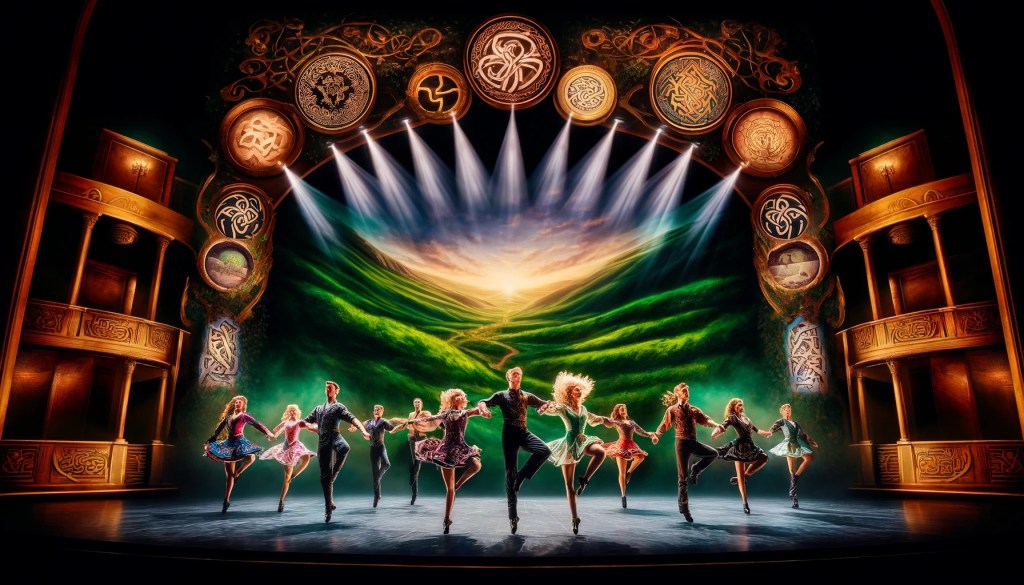
Riverdance
“Riverdance” is not a narrative performance in the traditional sense but rather a thematic exploration of Irish culture and history through music, dance, and folklore. It uses a variety of dance styles and musical pieces to evoke the spirit and transformation of Ireland.
Here’s a general outline of the thematic progression you see in “Riverdance”:
Act 1
1. The Heartbeat of the World
- Opening Sequence: The show opens with the thunderous rhythms of traditional Irish bodhrán drums, symbolizing the ancient heartbeat of Ireland’s culture and history.
2. The Countess Cathleen
- Women of the Sidhe: This piece is inspired by W.B. Yeats’ poem and portrays the story of Countess Cathleen who sells her soul to save her people during a famine.
3. Cú Chulainn
- Thunderstorm: A dramatic sequence that leads into the story of Cú Chulainn, one of Ireland’s legendary heroes, depicted through an intense dance performance.
4. Firedance
- Spanish Influence: Reflecting the historic influence of the Spanish on Irish culture, this fiery dance incorporates flamenco rhythms, showcasing the passion and intensity of both cultures.
5. Slow Air and Tunes
- Cultural Harmony: Featuring softer, lyrical pieces that showcase the uilleann pipes and the fiddle, reflecting the soulful side of Irish music and dance.
6. Finale of Act 1
- Riverdance: The first act culminates in the iconic “Riverdance” line, where the entire ensemble performs in synchronized, rapid-fire tapping, representing the flowing river—a metaphor for the journey of life and the continuous flow of Irish culture.
Act 2
1. American Wake
- Emigration: This piece reflects the 19th-century emigration of Irish people, combining the sorrow of departure with the hope for a new life in America.
2. Trading Taps
- Cultural Exchange: A fun, competitive tap dance between Irish dancers and African American tap dancers, symbolizing the meeting and melding of different cultures in America.
3. Russian Dervish
- Global Influences: Reflecting on the broader influences and connections of Celtic culture, this piece incorporates Russian folk dance elements.
4. Heartland
- Return to Roots: This emotional number represents the return to Irish roots, a spiritual homecoming, and a celebration of Irish identity and heritage.
5. Finale
- Reprise of Riverdance Theme: The show concludes with a grand finale that revisits themes from the opening, celebrating Irish culture’s vibrancy and its impact on the world.
A Celebration
“Riverdance” is a celebration of Irish music, dance, and culture but also speaks universally of migration, change, and the blending of cultures. It is a powerful expression of identity and heritage through the performing arts.
I have a deep affection for Irish music, dancing, and the entire Riverdance experience—from the show’s dynamic performances to its rich cultural tapestry. This art form has a unique way of touching your heart and blossoming within it.
In a way, it’s a journey back to our roots, a universal need that connects us all.

Hear my cry in my hungering search for you
Taste my breath on the wind
See the sky as it mirrors my colors
Hints and whispers begin

I am living to nourish you, cherish you
I am pulsing the blood in your veins
Feel the magic and power of surrender to life
Uisce Beatha

Every finger is touching, searching
Until your secrets come out
In the dance as it endlessly circles
I linger close to your mouth

I am living to nourish you, cherish you
I am pulsing the blood in your veins
Feel the magic and power of surrender to life
Uisce Beatha

Riverdance by Bill Whelan


 The Duck Pond Splash Down
Leave a comment