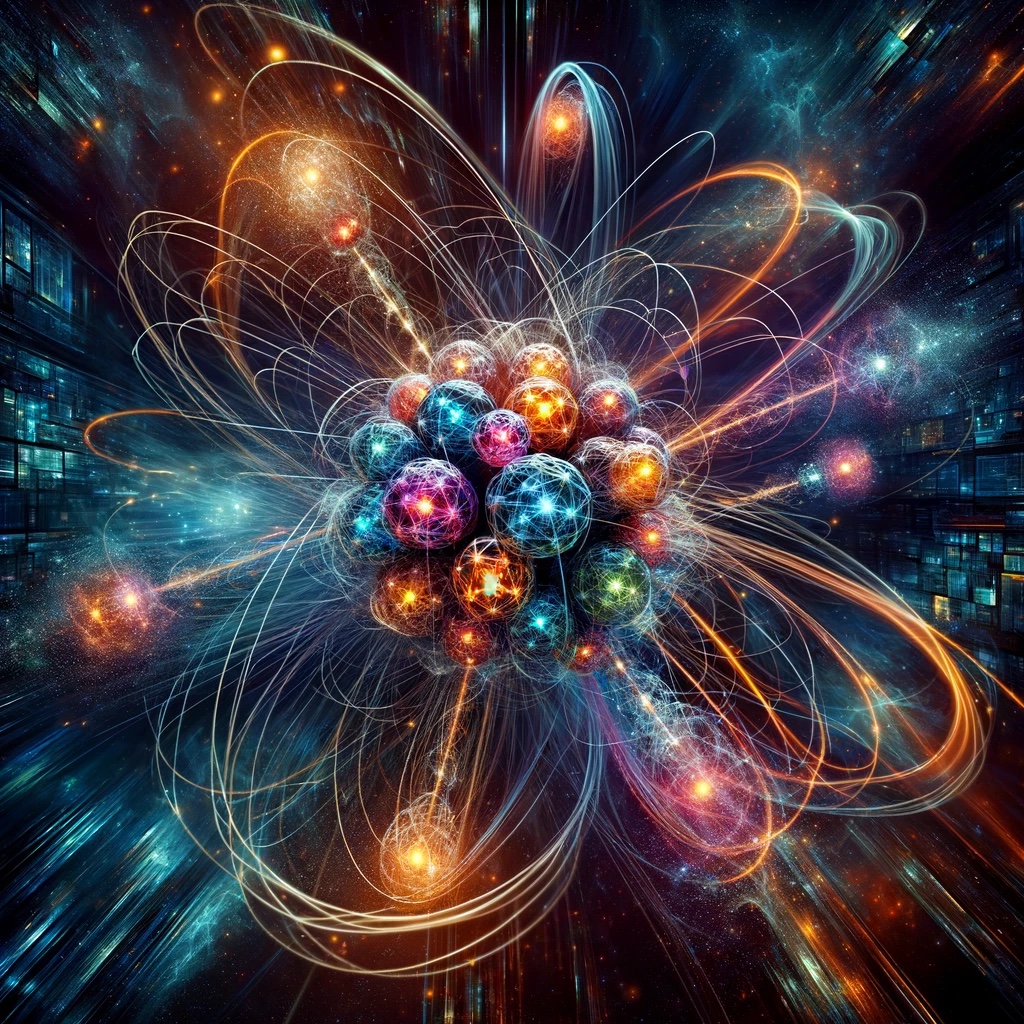
Hadrons are a class of subatomic particles that are best known as the components of atomic nuclei—specifically, protons and neutrons.
What distinguishes hadrons from other types of particles is that they are composite particles made of quarks, which are bound together by the strong force, one of the fundamental forces in physics.
Quarks and Gluons:
- Hadrons: Are made up of quarks…
- Quarks: Inside the hadrons, two or three quarks are held together by gluons…
- Gluons: Carry the strong force between the quarks, effectively “gluing” them together — to form Hadrons.
Categories of Hadrons
Hadrons are divided into two main types, or categories, based on their quark composition:
Baryons
- Composed of: Three quarks.
- Examples: Protons (made of two up quarks and one down quark) and neutrons (made of two down quarks and one up quark).
- Characteristics: Baryons have half-integer spins, making them fermions.
Mesons
- Composed of: A quark and an antiquark.
- Examples: Pions and kaons, which are important for mediating the strong force between nucleons (protons and neutrons in the nucleus).
- Characteristics: Mesons have integer spins, classifying them as bosons.
Properties of Hadrons
- Strong Interaction: The defining characteristic of hadrons is their interaction through the strong force, which is the most powerful of the four fundamental forces but acts over very short distances. This force not only binds quarks within hadrons but also holds hadrons together in nuclei.
- Colour Charge: Quarks carry a type of charge called “colour charge,” which is related to the strong force. Unlike electric charge, colour charge comes in three types (red, green, and blue), and the colors must always combine to form a colour-neutral particle, which is why quarks are confined within hadrons.
- Mass and Stability: The mass of hadrons is largely due to the energy of the strong force field within them, rather than the mass of the quarks themselves. This is described by Einstein’s equation ( E=mc^2 ), where most of the mass comes from the binding energy. Most hadrons are unstable, with only protons being stable under normal conditions.
- Integer or half-integer Spin: Spin has both a magnitude and a direction. The direction of a particle’s spin can take on different orientations relative to an external magnetic field (Spin will be covered in a later post).
Mesons and Baryons are Hadrons
Meson are pairs of quarks
Baryons are triplets of quarks
Gluons mediate the interactions between quarks in
Mesons and Baryons
Pions are a type of Meson
Pions
A type of Hadron consisting of a quark and its corresponding anti-quark are Mesons. One type of Mesons are pions:
- Pions (π): Involved in mediating the strong force between nucleons in the nucleus.
- π⁺ (Positive Pion): Consists of an up quark and an anti-down quark
- π⁰ (Neutral Pion): Can consist of either up quark and anti-up quark or down quark and anti-down quark, existing in a superposition of both states.
- π⁻ (Negative Pion): Made up of a down quark and an anti-up quark.
Superposition is a fundamental principle in quantum mechanics that describes how physical systems, like particles or waves, exist simultaneously in multiple possible states or configurations.
The concept of Superposition is crucial for understanding many aspects of quantum behaviour.


 The Duck Pond Splash Down
Leave a comment